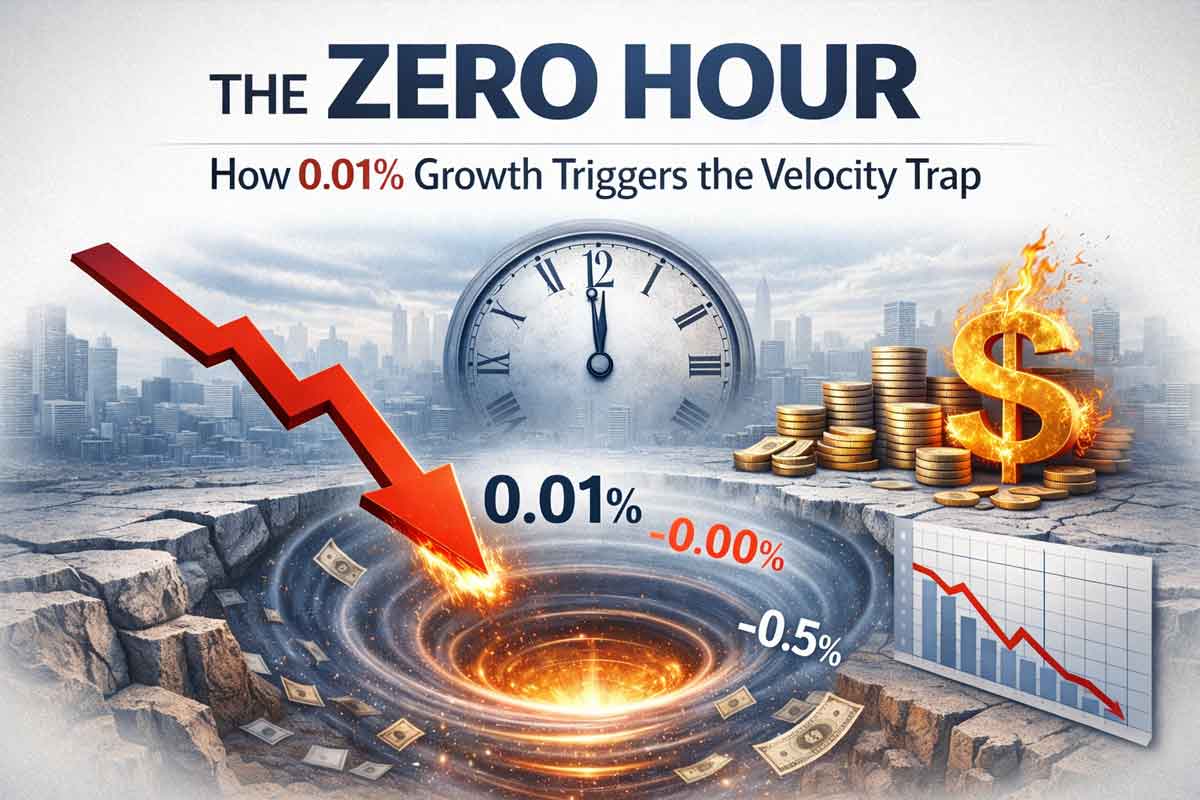
The number is an almost cruel whisper: $0.01\%$. This is not just a negligible statistical blip; it is a profound declaration of economic paralysis, a moment where the world’s largest economy teeters on the knife-edge between expansion and systemic reversal. Forget the clinical definition of a recession (two negative quarters); a period of near-zero growth, particularly a hypothetical $0.01\%$ annual rate, is arguably more dangerous. It’s a Velocity Trap, where the momentum required to absorb new workers, fund social programs, and service mountains of debt ($34.5$ trillion in national debt) vanishes, leaving the entire apparatus suspended in fragile stasis. This creates a terrifying Structural Schism, a stark reality where a tiny elite thrives on high-velocity sectors like AI while the foundational economy starves for oxygen.
The story behind this infinitesimal figure is the Great AI Decoupling. According to recent economic analysis, almost all of America’s expansion has been single-sourced, driven by colossal, high-dollar investment in information-processing equipment and data centres—the infrastructure of the AI boom. One stark finding suggests that if you surgically remove this concentrated, hyper-capitalized spending from the equation, the core growth rate for the rest of the US economy—the consumer spending, the traditional manufacturing, the small businesses—has effectively flatlined near $0.01\%$ in certain periods of 2025. This $0.01\%$ is the ghost image of the non-AI economy. This uneven architecture means the Watcher (the Federal Reserve) is blind: high aggregate GDP (which was around $+3.8\%$ in Q2 2025) masks the deep, corrosive weakness in nearly every other sector. The Fed’s policy manoeuvring—like the recent rate cuts—becomes a desperate gamble that may fail to revive the underlying, stagnant base.
The impact of this economic Near-Death Experience cascades directly into the lifeblood of the nation: the labour market and its debt load. The $0.01\%$ figure is not sustainable; it is a prologue to joblessness. Economists turn to Okun’s Law, which dictates that real GDP must grow at a pace significantly above its potential (estimated around $2.0\%$ to $2.5\%$) just to keep the unemployment rate from rising. Under near-zero growth, the math is brutal: businesses lack the revenue and confidence to retain workers, leading to inevitable layoffs. This drives the rise of the Sahm Rule—the silent alarm that signals a recession is already underway when joblessness ticks up $0.5$ percentage points from its low. Furthermore, a near-zero growth rate severely exacerbates the national debt crisis. With debt near $120\%$ of GDP, a lack of growth means the government must borrow perpetually just to pay the escalating interest costs, which now eclipse spending on national defence, ensuring the financial pressure only intensifies.
In conclusion, the whisper of $0.01\%$ growth is the most potent warning sign of a systemic crisis. It means the majority of the U.S. economy has lost its forward propulsion, entering a Soggy Growth environment where opportunities diminish and debt pressure intensifies. It’s a moment of maximum fragility: any external shock—a geopolitical event, a supply chain hiccup, or a prolonged consumer pullback—could instantly tip the scale from precarious stasis into a full-scale recessionary event. The lesson is clear: relying on a narrow, hyper-growth sector cannot sustain the colossal needs of a multi-trillion-dollar economy. The survival of the American financial apparatus now hangs on whether the residual inertia can overcome the dead weight of the decoupled economy.