When Scale Slows, Relevance Is at Risk
Organisations rarely fail abruptly. More often, they drift – gradually losing velocity as markets evolve faster than internal systems. In today’s environment of technological acceleration, regulatory complexity, and shifting consumer expectations, the inability to scale or adapt is not a function of ambition, but of alignment. Strategic change management becomes essential when growth plateaus not because opportunities disappear, but because organisational models no longer match market reality.
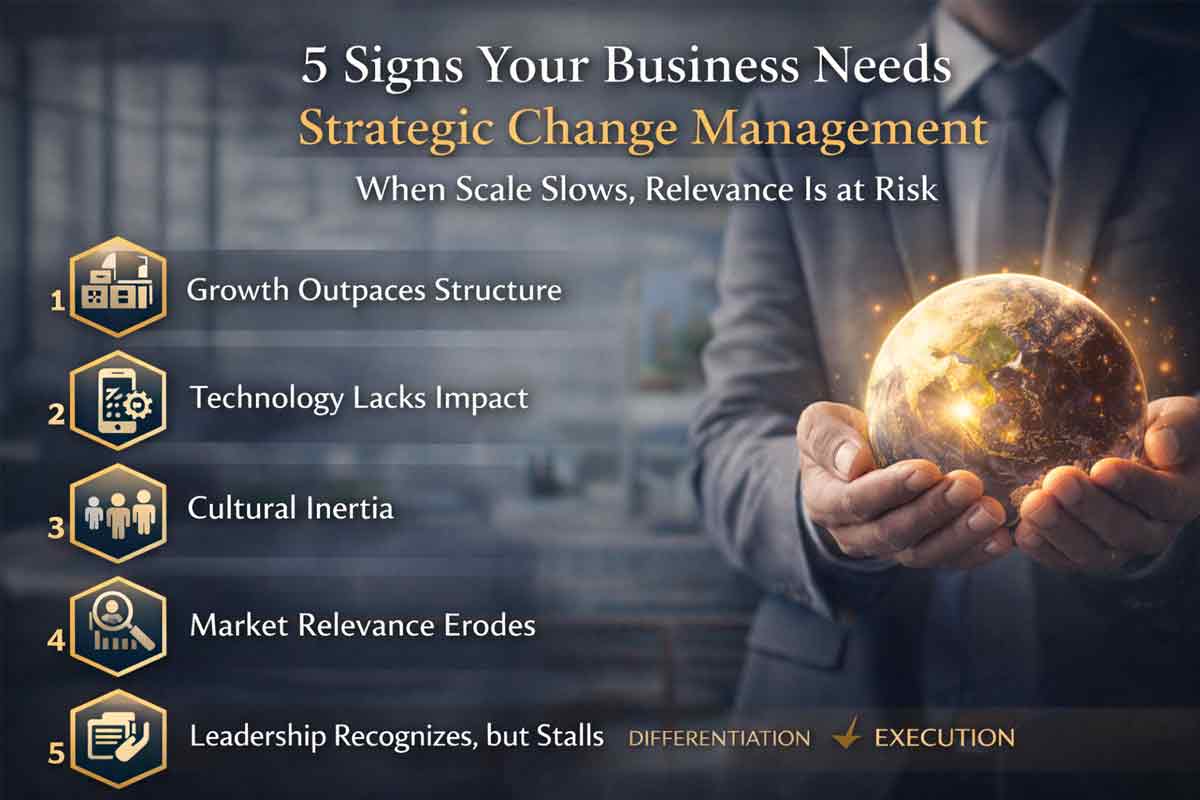
The first sign appears when operational scale outpaces structural design. In manufacturing, this is visible when production capacity increases but supply-chain coordination, vendor integration, and workforce readiness lag behind. Plants expand, yet productivity stagnates. In IT services, rapid client acquisition often leads to fragmented delivery models and inconsistent quality. Infopace addresses this through enterprise diagnostics and operating model redesign, enabling organisations to realign structure, processes, and governance with growth objectives – transforming scale from a liability into a capability.
A second signal emerges when digital adoption fails to deliver strategic impact. Hospitals invest in health-tech platforms, educational institutions deploy learning management systems, and enterprises migrate to cloud infrastructure – yet decision-making remains manual and outcomes incremental. This reflects technology implementation without change orchestration. Infopace’s digital transformation and analytics advisory ensures that technology investments are embedded within organisational workflows, supported by data-driven decision frameworks, and adopted through structured change enablement – converting digital spend into measurable performance gains.
The third sign is cultural inertia, often mistaken for stability. In healthcare systems, clinical excellence may remain strong while administrative processes resist change. In education, institutions struggle to align faculty, curriculum, and employability outcomes with evolving industry needs. Here, Infopace applies human-centric change management and leadership alignment frameworks, enabling leaders to communicate transformation intent clearly, build ownership across teams, and institutionalise new ways of working without eroding trust or purpose.
A fourth indicator arises when market relevance begins to erode. Manufacturing firms face commoditisation, IT companies confront margin compression due to automation and AI, and education providers compete in an overcrowded credentials market. Infopace’s strategic repositioning and go-to-market advisory assists organisations reassess their value propositions, identify emerging demand spaces, and repurpose existing capabilities for higher-value market segments – ensuring differentiation remains credible and future-ready.
The final and most decisive sign is when leadership recognises the need for change but lacks an execution pathway that balances transformation with continuity. This is where many organisations stall. Infopace operates precisely at this junction, acting as a strategic change partner rather than a transactional consultant. Through policy advisory, ecosystem development, MSME enablement, and program management services, Infopace translates strategic intent into execution-ready roadmaps – ensuring that change is absorbed institutionally, not disrupted episodically.
Strategic change management is no longer a corrective measure reserved for moments of crisis. It is a foundational capability for organisations seeking longevity in volatile environments. Enterprises that act early – guided by structured insight and disciplined execution – do not merely overcome stagnation; they redefine their trajectory. By aligning strategy, systems, and people, Infopace enables organisations across sectors to evolve with confidence, resilience, and sustained relevance.
Disclaimer:
This article is for informational and thought-leadership purposes only. Views expressed are interpretative and based on publicly available information as of the date of publication. References to policies, budgets, or Infopace initiatives are illustrative and do not constitute legal, financial, or investment advice. Readers are encouraged to consult official sources and professional advisors where appropriate.