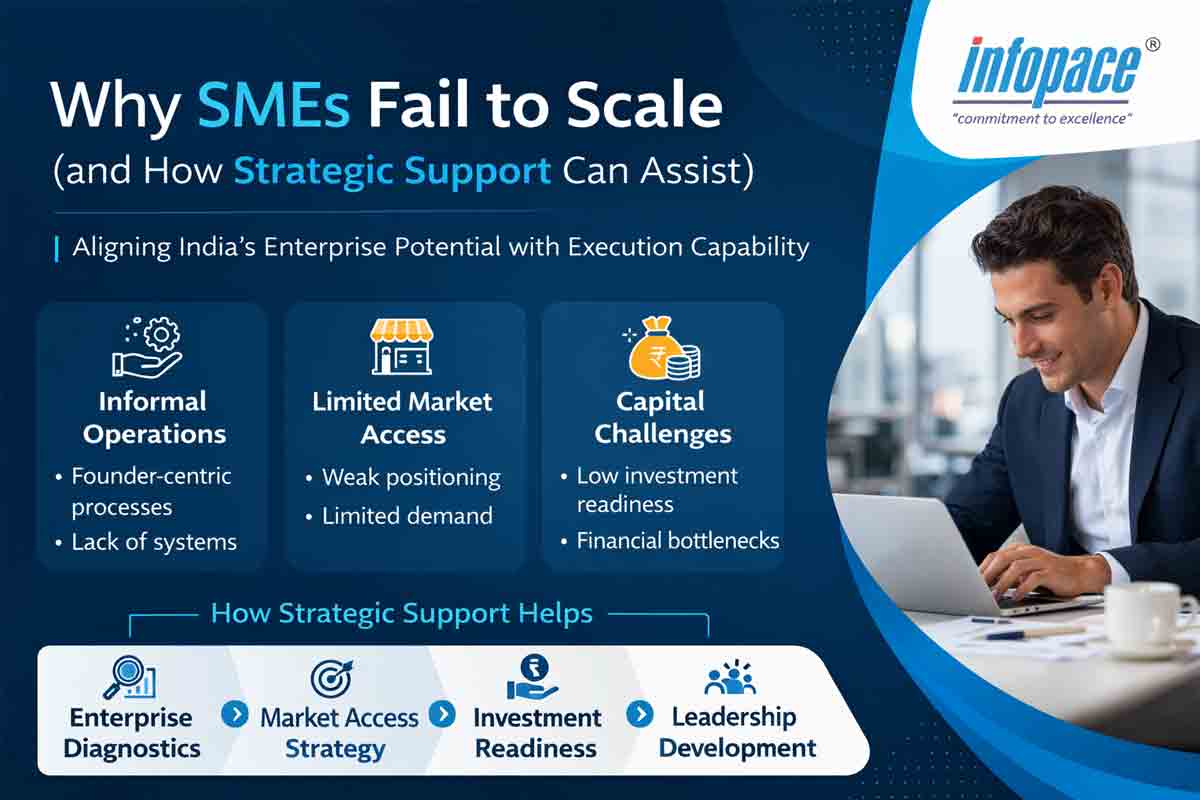
Aligning India’s Enterprise Potential with Execution Capability
India’s SME sector stands at the centre of the nation’s economic ambition. It fuels employment, anchors regional economies, and supplies critical links across domestic and global value chains. Yet, despite favourable demographics, policy intent, and entrepreneurial energy, a majority of SMEs struggle to move beyond a certain threshold of growth. The challenge is not market opportunity – it is the absence of structured capability to scale. Scaling, in the Indian SME context, is less about speed and more about readiness.
One of the most common reasons SMEs fail to scale is the persistence of informal operating models. Founder-centric decision-making, undocumented processes, and fragmented governance may enable early survival but quickly become bottlenecks as volumes increase. Infopace addresses this through its Enterprise Diagnostics and Growth Strategy Advisory services. By evaluating organisational structure, process maturity, financial health, and market positioning, Infopace assists SMEs transition from intuition-led operations to system-driven enterprises capable of handling complexity without losing agility.
A second barrier lies in constrained market access and weak positioning. Many Indian SMEs deliver strong products or services but remain confined to low-margin roles due to limited branding, inadequate go-to-market strategies, and lack of institutional buyer readiness. Infopace’s Go-to-Market and Market Access Advisory enables SMEs to reframe their value propositions, identify high-potential demand segments, and enter structured markets – both domestic and international. This service pillar is critical in assisting SMEs evolve from local suppliers into competitive participants in broader value chains.
Capital remains another misunderstood constraint. While access to finance is often cited as a challenge, the deeper issue is capital readiness. Inadequate compliance, weak financial structuring, and unclear growth narratives restrict SMEs from attracting the right kind of funding. Infopace supports enterprises through Investment Readiness and Financial Structuring Advisory, ensuring alignment with lender and investor expectations. By strengthening governance, documentation, and scalability narratives, Infopace enables SMEs to absorb growth capital responsibly and deploy it effectively.
Equally important is the human dimension of scale. As enterprises grow, leadership roles must evolve, teams must align to new objectives, and culture must support transformation. Without this, growth initiatives stall due to internal friction. Infopace integrates Strategic Change Management, Leadership Development, and Capability-Building Programs into its growth acceleration engagements. These interventions ensure that people systems, leadership mindsets, and execution capacity scale in parallel with business ambitions.
India’s SME challenge is not a lack of entrepreneurial intent – it is a gap between potential and preparedness. Scaling requires more than incentives; it demands structured support that connects strategy, systems, markets, capital, and people. As a Growth Acceleration Partner, Infopace operates across these dimensions – translating policy opportunity and market potential into enterprise capability. In doing so, it enables SMEs not merely to grow larger, but to grow stronger, more resilient, and globally relevant.
Disclaimer:
This article is for informational and thought-leadership purposes only. Views expressed are interpretative and based on publicly available information as of the date of publication. References to policies, budgets, or Infopace initiatives are illustrative and do not constitute legal, financial, or investment advice. Readers are encouraged to consult official sources and professional advisors where appropriate.