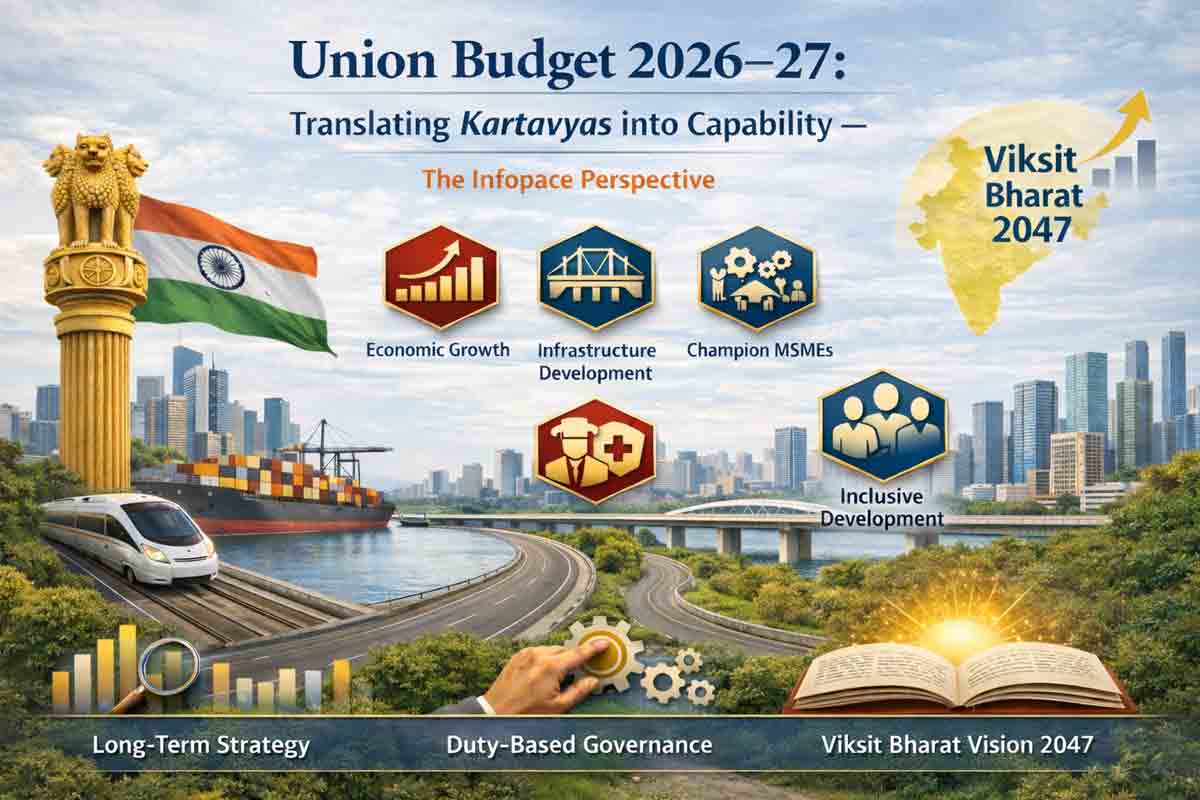
The Union Budget 2026–27 is widely regarded as a strategic blueprint for Viksit Bharat 2047, outlining India’s long-term ambition to evolve into a developed, resilient, and inclusive economy. Rather than responding to short-term macroeconomic pressures, the Budget introduces a duty-based governance framework through the articulation of six Kartavyas – placing growth, human capacity, and inclusion at the core of national responsibility. This marks a shift from episodic fiscal management to deliberate, long-horizon capacity creation.
For institutions engaged in policy execution, enterprise enablement, and ecosystem development, this Budget serves as an operational compass. At Infopace, this direction resonates deeply with work undertaken well before the current policy moment. As early as December 2015, Infopace articulated a forward-looking development framework through its Vision 2040 Plan for the State of Karnataka, a policy-oriented article shared selectively within institutional and government ecosystems. The framework emphasised infrastructure as an economic system, enterprise-led growth, regional capacity creation, and human capital as the foundation of sustained development – principles that now find structured expression in Budget 2026–27.
First Kartavya: Accelerating and Sustaining Economic Growth
The First Kartavya reframes economic growth as a governing obligation rather than a cyclical outcome. In a fragile global environment, the Budget prioritises sustained growth built on durable assets, institutional confidence, and productive capacity. The allocation of ₹12.2 lakh crore toward capital expenditure in FY27 underscores this intent, positioning infrastructure, manufacturing, and digital public goods as long-term growth anchors.
This perspective closely mirrors Infopace’s long-standing approach to economic development. In its 2015 Vision 2040 framework, growth was defined not by short-term expansion but by the creation of compounding national capacities. Today, Infopace supports this Kartavya through policy advisory, economic visioning, and ecosystem design – working with governments and institutions to translate growth intent into region-specific, execution-ready strategies that prioritise longevity over volatility.
Infrastructure Development at Scale: From Spend to System
Infrastructure remains the structural spine of the Budget’s growth strategy. Investments in high-speed rail corridors, freight networks, City Economic Regions (CERs), and multimodal connectivity reflect a shift from asset creation to economic architecture building – where infrastructure reduces friction, integrates markets, and amplifies enterprise productivity across regions.
Infopace has consistently approached infrastructure through this systems lens. Its Vision 2040 Plan (2015) positioned infrastructure as an enabler of enterprise ecosystems rather than a standalone public investment. Building on this thinking, Infopace today supports regional development planning, stakeholder coordination, and data-backed frameworks that link infrastructure investments to MSME participation, employment generation, and regional competitiveness – particularly across Tier-II and Tier-III geographies.
Creating Champion MSMEs: Scaling Capability, Not Just Count
The Budget’s MSME agenda signals a decisive shift – from survival-oriented support to competitiveness and scale creation. Initiatives such as the SME Growth Fund, improved credit access, and compliance facilitation aim to nurture globally competitive, technology-enabled MSMEs capable of integrating into national and international value chains.
Infopace’s enterprise enablement initiatives align closely with this vision. Drawing from principles outlined in its earlier policy work, Infopace supports MSMEs through entrepreneurship development programs, enterprise diagnostics, compliance and market-access facilitation, and program management for institutional MSME initiatives. This ensures that policy incentives are matched with enterprise readiness, enabling MSMEs to evolve into sustainable growth engines rather than remain fragmented participants in the economy.
Second Kartavya: Fulfilling Aspirations and Building Human Capacity
The Second Kartavya recognises that economic growth is ultimately anchored in human capability. Investments across skilling, education, healthcare, tourism, sports, and creative industries reflect a commitment to converting India’s demographic advantage into productive capital. By aligning aspiration with employability and enterprise creation, the Budget strengthens India’s long-term competitiveness.
Infopace has consistently treated human capital as an ecosystem lever rather than a standalone intervention – a principle articulated in its Vision 2040 thinking. Through skill development initiatives, entrepreneurship training, workforce readiness programs, and institution-led capacity building, Infopace bridges the gap between aspiration and opportunity, ensuring that talent development feeds directly into enterprise growth and regional economic outcomes.
Third Kartavya: Inclusive Development as a Growth Multiplier
Inclusive development is embedded as a central growth strategy rather than a parallel objective. The Budget’s focus on agriculture, women-led development, regional equity, and social inclusion reinforces the principle that growth must be broad-based to be sustainable.
This philosophy has long informed Infopace’s execution models. From women entrepreneurship cohorts to regionally anchored enterprise programs and community-linked development initiatives, Infopace integrates inclusion into economic design. Such alignment transforms inclusion from a welfare lens into a productivity multiplier, strengthening the depth and resilience of the growth process.
Conclusion: From Policy Vision to Institutional Execution
Union Budget 2026–27 represents a long-game policy manifesto aligned with India’s ambition for Viksit Bharat 2047. Its true impact, however, will be determined by execution – by institutions capable of translating policy intent into enterprise capability, human capital strength, and regional transformation.
Infopace operates precisely at this intersection. Its work – rooted in early thought leadership such as the Vision 2040 Plan for Karnataka (published in December 2015) and advanced through ongoing policy advisory, MSME enablement, and ecosystem development initiatives – reflects a continuity of purpose rather than a reaction to the moment. As India advances along its Kartavya-led development path, institutions that quietly build systems, capacities, and confidence will shape the nation’s next phase of growth – and Infopace remains committed to that role.
Related Thought Leadership
Infopace’s long-horizon development thinking was articulated nearly a decade ago through its publication “Vision 2040: A Development Plan for the State of Karnataka” (December 2015). The article explored regional capacity creation, infrastructure-led growth, enterprise ecosystems, and human capital as interdependent drivers of long-term economic transformation. While not widely circulated, it was positioned as a working framework for policymakers and ecosystem builders.
🔗 Read the Vision 2040 article here:
https://infopacemanagement.blogspot.com/2015/12/vision-2040-plan-for-state-of-karnataka.html
Disclaimer:
This article is for informational and thought-leadership purposes only. Views expressed are interpretative and based on publicly available information as of the date of publication. References to policies, budgets, or Infopace initiatives are illustrative and do not constitute legal, financial, or investment advice. Readers are encouraged to consult official sources and professional advisors where appropriate.