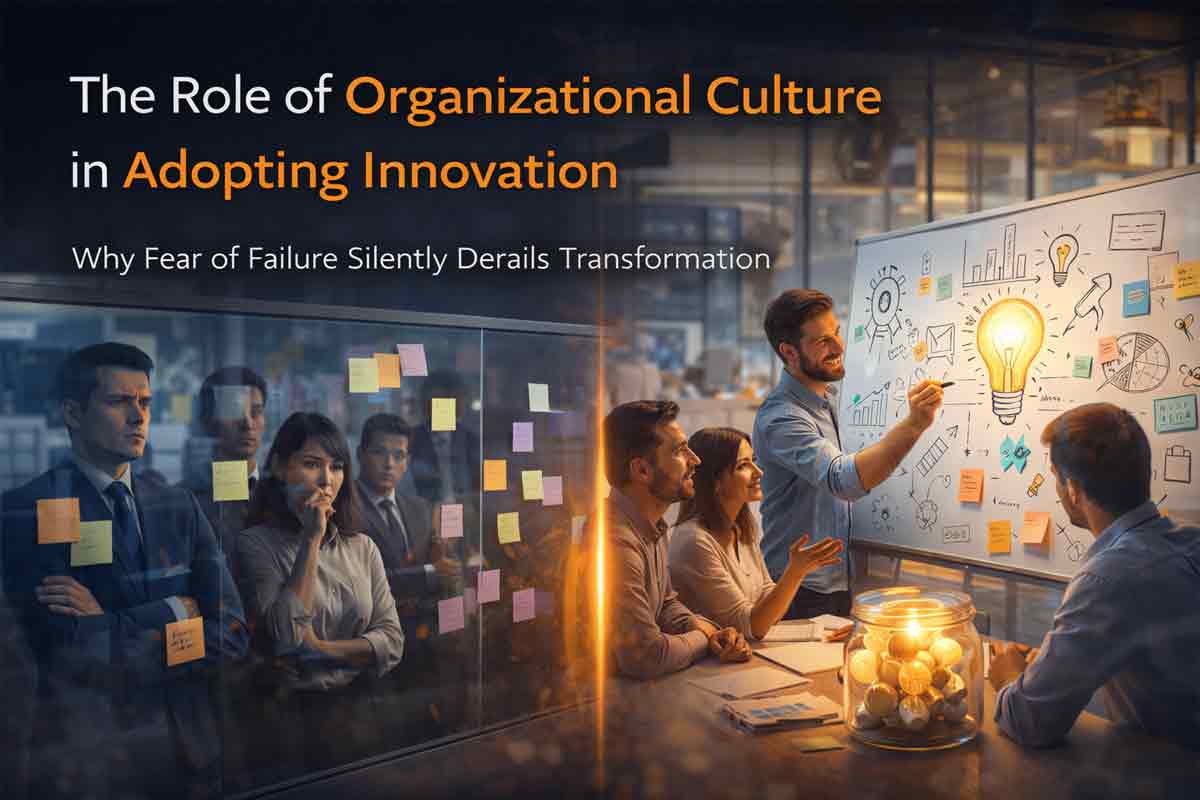
Why Fear of Failure Silently Derails Transformation
Innovation rarely fails because of inadequate ideas. It fails because the environment meant to nurture those ideas quietly resists them. Across industries – manufacturing, IT services, healthcare, education – organisations invest in new technologies, new strategies, and new growth initiatives. Yet, beneath the formal announcements lies an unspoken reality: employees hesitate, managers protect existing systems, and leadership inadvertently signals risk aversion. Fear of failure and resistance to change become invisible barriers that stall innovation before it gains momentum.
At the workplace level, this resistance is rarely dramatic. It appears as cautious decision-making, delayed approvals, excessive compliance layers, or silent disengagement from experimentation initiatives. In manufacturing units, frontline managers may avoid process redesign fearing production disruptions. In IT firms, teams may resist AI-led automation due to perceived job displacement. In healthcare and education, professionals may question digital systems that challenge established routines. These reactions are not irrational – they reflect uncertainty about accountability, performance expectations, and long-term implications.
The core issue is cultural alignment. When performance systems reward stability over experimentation, innovation becomes performative. When failure carries reputational risk, employees choose predictability over possibility. Infopace addresses this through its Strategic Change Management and Organizational Diagnostics Services, beginning with a structured assessment of cultural readiness. By identifying behavioural bottlenecks, decision hierarchies, and incentive misalignments, Infopace enables leadership to understand not just what needs to change, but why resistance exists.
Cultural transformation requires more than communication campaigns. Through its Leadership Development and Alignment Programs, Infopace works closely with executive teams to recalibrate performance metrics, redefine accountability structures, and model innovation-oriented behaviours. Leaders are equipped to articulate change narratives that reduce uncertainty and build trust. Innovation is repositioned from a threat to stability into a pathway for relevance.
Equally important is capability building at all organisational levels. Infopace integrates Workforce Readiness and Capability-Building Interventions into transformation programs, ensuring employees are equipped with both technical and adaptive skills. Training initiatives are aligned with innovation goals, assisting teams transition confidently into new roles and workflows rather than resisting them defensively.
To ensure sustainability, Infopace’s Program Governance and Ecosystem Development Services embed innovation into institutional processes – establishing clear experimentation frameworks, milestone reviews, and feedback mechanisms. This prevents innovation from remaining an isolated initiative and instead integrates it into operational strategy.
Organisational culture does not transform through slogans. It evolves when systems, incentives, leadership behaviour, and employee capability move in alignment. Fear of failure diminishes when accountability is shared, clarity is strengthened, and learning is institutionalised.
In an era defined by technological acceleration and competitive volatility, innovation adoption is not solely a strategic challenge – it is a cultural one. By integrating diagnostics, change management, leadership alignment, capability building, and structured governance, Infopace enables organisations to move beyond resistance and build cultures where innovation is not episodic, but enduring.
Culture, when intentionally designed, becomes the most powerful enabler of transformation.
Disclaimer:
This article is for informational and thought-leadership purposes only. Views expressed are interpretative and based on publicly available information as of the date of publication. References to policies, budgets, or Infopace initiatives are illustrative and do not constitute legal, financial, or investment advice. Readers are encouraged to consult official sources and professional advisors where appropriate.