From Uncertainty to Alignment in Times of Transformation
Change today is no longer episodic – it is continuous. Whether driven by digital transformation, regulatory shifts, AI adoption, market realignments, or economic volatility, organisations are navigating rapid transitions at an unprecedented pace. Yet while strategies evolve quickly, internal alignment often lags behind. Teams grow uncertain, communication becomes fragmented, and productivity dips. The core issue is rarely the strategy itself; it is the absence of structured leadership communication and people-centric change execution.
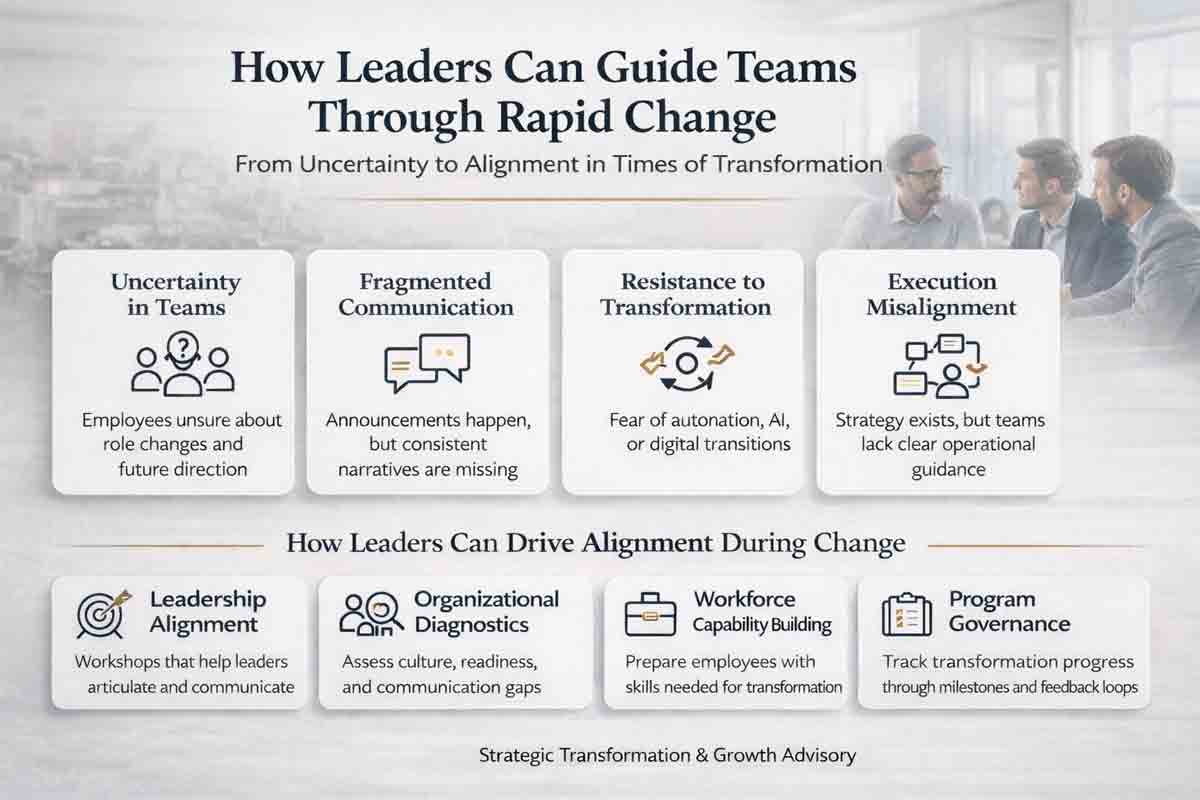
In moments of rapid transformation, leaders frequently face a dual pressure: maintaining performance while driving change. Communication becomes reactive rather than intentional. Announcements are made, but narratives are not sustained. In manufacturing, production teams may struggle to understand automation roadmaps. In IT organisations, employees may question how AI integration will reshape roles. In healthcare and education, professionals may feel overwhelmed by digital transitions without clarity on long-term purpose. Without coherent communication, uncertainty quickly translates into resistance.
Effective change leadership requires more than frequent updates – it demands structured alignment between vision, behaviour, and execution. Infopace addresses this through its Leadership Development and Strategic Alignment Services, designed to equip leaders with the frameworks necessary to communicate transformation with clarity and credibility. This includes leadership workshops focused on change articulation, stakeholder mapping, and narrative consistency – ensuring that strategic shifts are understood not only at the executive level, but across operational tiers.
However, communication alone does not guarantee adoption. Leaders must also redesign systems that reinforce change. Through its Strategic Change Management and Organizational Diagnostics Services, Infopace evaluates cultural readiness, identifies communication gaps, and aligns incentive structures with transformation goals. Leaders are supported in translating high-level strategy into measurable actions – defining milestones, accountability structures, and feedback loops that embed change into everyday operations.
Equally critical is workforce enablement. Rapid change often demands new competencies, adaptive mindsets, and cross-functional collaboration. Infopace integrates Capability-Building and Workforce Readiness Programs into transformation initiatives, ensuring employees possess both the technical and behavioural skills required to operate in new environments. This reduces fear-driven resistance and strengthens engagement.
To maintain continuity during transition, Infopace’s Program Governance and Execution Advisory Services provide structured oversight- sequencing initiatives, monitoring adoption metrics, and mitigating execution risk. Leaders gain visibility into transformation progress, enabling timely interventions and transparent communication with stakeholders.
Guiding teams through rapid change is ultimately about trust. Trust is built when communication is consistent, direction is clear, and leadership behaviour aligns with stated objectives. In the absence of structured support, even well-intentioned leaders may struggle to sustain momentum.
By integrating leadership development, change management, capability building, diagnostics, and governance frameworks, Infopace enables organisations to navigate rapid change without destabilising performance. Leaders move from reacting to disruption toward orchestrating transformation – converting uncertainty into alignment and alignment into sustained growth.
In an environment defined by acceleration, the organisations that endure will be those whose leaders treat communication not as a formality, but as the strategic backbone of change.
Disclaimer:
This article is for informational and thought-leadership purposes only. Views expressed are interpretative and based on publicly available information as of the date of publication. References to policies, budgets, or Infopace initiatives are illustrative and do not constitute legal, financial, or investment advice. Readers are encouraged to consult official sources and professional advisors where appropriate.